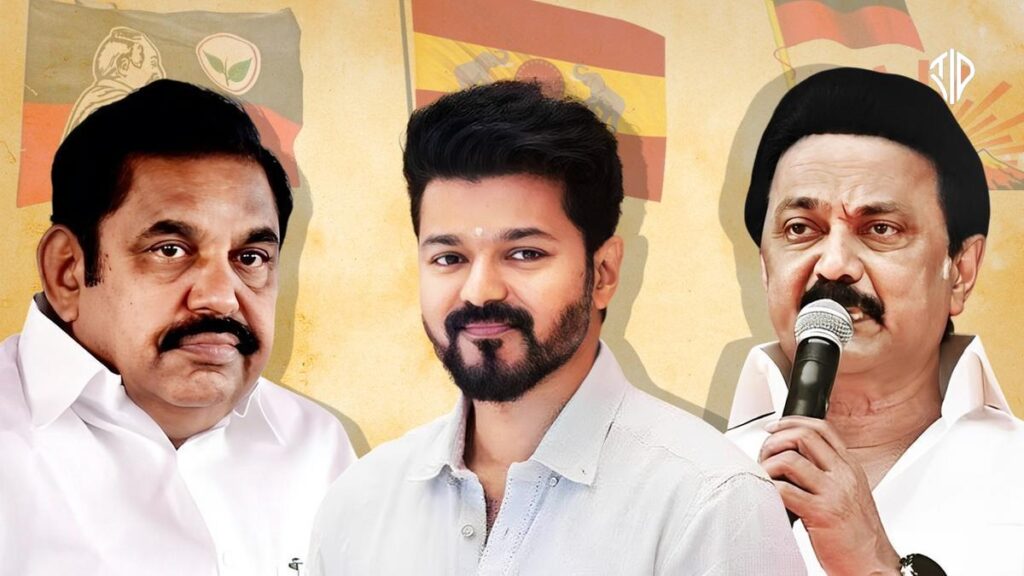
An analytical exploration of actor Vijay’s Tamilaga Vettri Kazhagam (TVK) and its potential to disrupt the traditional Dravidian duopoly. This post evaluates the solo strategy of TVK and its impact on vote fragmentation in the 2026 assembly elections.
The transition from the silver screen to the political pulpit in Tamil Nadu is a storied tradition, yet the upcoming 2026 assembly election introduces a unique variable. Actor Vijay has officially launched Tamilaga Vettri Kazhagam (TVK), opting to bypass traditional alliances in favor of a solo campaign that challenges the long-standing Dravidian duopoly.
While the state is accustomed to charismatic leaders, the structural reality of the first-past-the-post system poses a significant hurdle. This is an electoral mechanism where the candidate with the highest number of votes wins a seat, even without a majority. This strategy forces a confrontation between celebrity momentum and the deep-rooted organizational machinery.
The Historical Logic of Alliances
For decades, Tamil Nadu’s electoral map has been defined by coalition arithmetic. Success usually depends on the ability to stitch together diverse interest groups. Since the late 1960s, power has largely alternated between the Dravida Munnetra Kazhagam (DMK) and the All India Anna Dravida Munnetra Kazhagam (AIADMK), both of which utilize extensive cadre networks.
History suggests that solo players often struggle to convert popularity into legislative presence. Even major shifts, like the AIADMK victory in 2016, were led by an established incumbent rather than a new entrant. New parties typically find that while they can attract large crowds, the lack of a booth-level organization limits their ability to win specific seats.
Comparing Political Structures
To understand how TVK compares to existing giants, we must look at the organizational depth and alliance strategies that define the current landscape.
| Feature | DMK & AIADMK | Naam Tamizhar Katchi (NTK) | TVK (Proposed) |
|---|---|---|---|
| Alliance Strategy | Strong Coalition Focus | Strictly Independent | Solo/Anti-Establishment |
| Base Support | Caste-Class Coalitions | Tamil Nationalists | Youth & Urban Voters |
| Ground Network | Multi-generational Cadre | Lean & Ideological | Fan-Club Conversion |
| Fiscal Model | Welfare-Heavy Spending | Radical Policy Shifts | Reformist & Youth Centric |
The NTK Precedent and Vote Share
A vital parallel for TVK is the Naam Tamizhar Katchi (NTK), led by Seeman. Over the last decade, NTK has seen a steady rise in vote share, reaching approximately 7 per cent in 2021. However, because their votes are spread thinly across 234 constituencies, they have failed to secure a single seat in the assembly.
TVK faces a similar risk of becoming a vote-cutter. If Vijay’s party secures a significant portion of the urban and youth vote, it may not win many seats itself. Instead, it could inadvertently benefit the ruling DMK by splitting the anti-incumbency votes that would otherwise go to the AIADMK or the NDA.
Visualizing the Electoral Impact
The following data illustrates the potential shifts in vote distribution if a third major solo player enters the fray with a projected 8-12% impact:
- DMK Alliance (Core): 40%
- AIADMK Alliance (Core): 30%
- TVK (Potential Shift): 10%
- NTK (Consistent): 7%
- Others / BJP: 13%
Strategic Challenges of Going Solo
Building a statewide electoral machine from scratch is a monumental task. Unlike established parties that rely on local influencers and decades-old booth committees, TVK is currently in a phase of ground structuring. Without this micro-level apparatus, even a favorable swing in public sentiment can dissipate before it reaches the ballot box.
The party’s narrative focuses on anti-corruption and economic mobility for the youth. By positioning himself as an alternative to both Dravidian giants, Vijay aims to capture the politically disengaged. However, rivals often point to a lack of administrative experience, suggesting that governance requires more than just a massive screen presence.
Key Takeaways for Voters
- Monitor Booth-Level Activity: Watch if TVK can convert fan clubs into functional administrative units at the local level.
- Observe Urban Trends: High turnout in cities like Chennai or Coimbatore for TVK may indicate a shift in the middle-class vote.
- Analyze Split-Vote Risks: Consider how a third-party vote might change the winner in your specific constituency under the current system.
The 2026 election will serve as a definitive stress test for Tamil Nadu’s political architecture. Whether Vijay can rewrite the rules of realpolitik or simply reinforce the dominance of the existing giants remains the central question for the coming year.
Follow us on Instagram (@inner_detail) for more updates in your feed.