CHENNAI — On May 4, 2026, the political foundations of Tamil Nadu, which had remained largely bipolar for over half a century, were shaken to the core. The results of the 17th Legislative Assembly elections have not just declared winners and losers; they have heralded the birth of a new era.
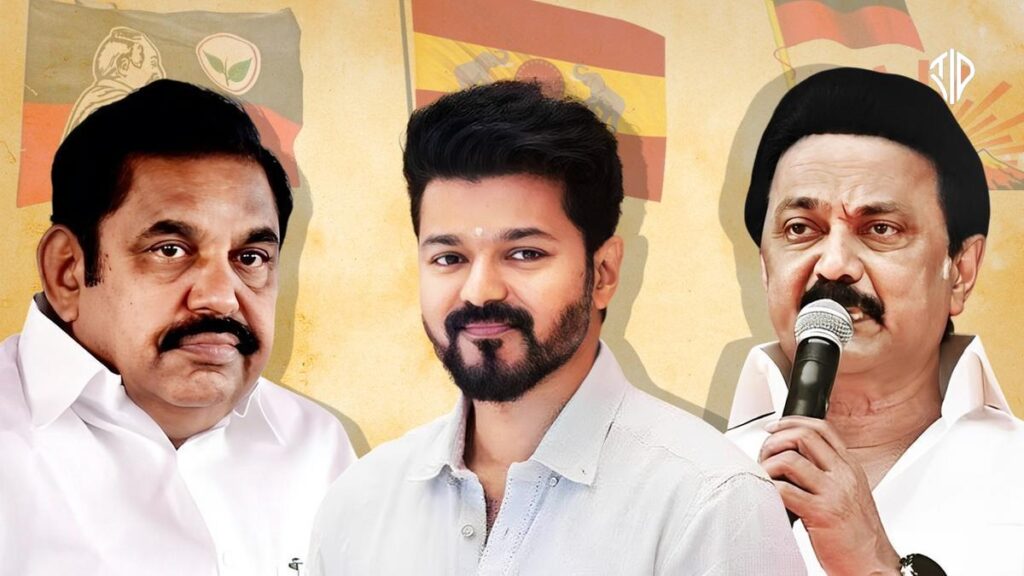
Thalapathy Vijay’s Tamilaga Vettri Kazhagam (TVK) has emerged as the single largest party in its debut performance, dismantling the dominance of the Dravida Munnetra Kazhagam (DMK) and the All India Anna Dravida Munnetra Kazhagam (AIADMK). While the state is currently navigating the complexities of a hung assembly, the mandate is clear: the people of Tamil Nadu have opted for a “Third Way.”
A Three-Cornered Verdict
The Election Commission of India (ECI) concluded the counting process late Monday night, revealing a fragmented house where no single party reached the magic number of 118 required for a majority.
Party-Wise Seat Distribution (2026)
| Party / Alliance | Seats Won | Vote Share (%) | Change from 2021 |
| Tamilaga Vettri Kazhagam (TVK) | 108 | 34.92% | +108 (New) |
| Dravida Munnetra Kazhagam (DMK) | 59 | 24.19% | -74 |
| AIADMK | 47 | 21.21% | -19 |
| Indian National Congress (INC) | 5 | 3.37% | -13 |
| Pattali Makkal Katchi (PMK) | 4 | 2.17% | -1 |
| Viduthalai Chiruthaigal Katchi (VCK) | 2 | 1.09% | -2 |
| Left Parties (CPI/CPIM) | 4 | 1.26% | -4 |
| BJP | 1 | 2.97% | -3 |
| Others (AMMK/DMDK) | 4 | 4.82% | +3 |
| Naam Tamilar Katchi (NTK) | 0 | 4.00% | 0 |
Visualizing the Seat Share
The following chart illustrates the dramatic shift in the Assembly’s composition, highlighting TVK’s dominance over the traditional Dravidian giants.
Key Takeaways from the 2026 Mandate
- The “Vijay” Phenomenon: TVK’s performance is the most successful debut for a film star’s party in Indian history, surpassing even the initial ripples created by MGR or NTR.
- Decimation of the DMK: In a shocking turn of events, Chief Minister M.K. Stalin lost his seat in Kolathur to TVK’s V.S. Babu, signaling a massive anti-incumbency wave.
- The Hung Assembly Dilemma: With TVK at 108 seats (10 short of a majority), Tamil Nadu faces its first hung assembly in decades, triggering intense post-poll negotiations.
- The Gen-Z Factor: Exit polls and final data suggest a massive consolidation of first-time and youth voters (ages 18–30) toward the TVK.
- Traditional Strongholds Crumble: The AIADMK suffered significant losses in its Western “Kongu” belt, while the DMK lost its grip on the Cauvery Delta region.
Detailed Analysis: Who Won and Why?
The 2026 election results represent more than just a change in leadership; they signify a structural realignment of the Tamil electorate. Below is an elaborate analysis of the three pillars that defined this historic outcome.
1. The TVK Surge: Beyond the Silver Screen
Vijay’s Tamilaga Vettri Kazhagam (TVK) did not win on “stardom” alone; it won on a sophisticated dual-targeting strategy that neutralized both the state and central incumbents. By labeling the DMK as his “Political Enemy,” he attacked the immediate governance failures, and by calling the BJP his “Ideological Foe,” he shielded himself from accusations of being a “proxy” for national interests.
- The “Volunteer” Infrastructure: Long before the 2026 notification, the Vijay Makkal Iyakkam (his fan-base-turned-political-cadre) underwent a professional transformation. They pivoted from organizing movie screenings to running “Thalapathy Clinics,” free evening tuition centers, and rapid-response disaster relief teams during the 2024 floods. This built a “Welfare Credit” that traditional parties could not match with eleventh-hour campaign promises.
- The Urban Fortress: TVK’s dominance in Chennai (winning high-profile seats like Anna Nagar and Mylapore) is particularly significant. Historically, Chennai was the DMK’s impenetrable fortress. Vijay’s message of “Modern, Clean Governance” resonated with the urban middle class and tech-savvy youth who were tired of the “Dravidian vs. Aryan” rhetoric and wanted solutions for urban flooding, traffic, and Ease of Doing Business.
- Neutralizing the “B-Team” Tag: By taking an aggressive stance against the BJP’s centralized policies, Vijay captured the “Tamil Nationalist” sentiment that usually went to the NTK or DMK, but paired it with a pragmatic economic vision that made him appear more “CM-material” than his contemporaries.
2. The Fall of the DMK: A Cabinet in Shambles
The DMK’s descent from a landslide in 2021 to a distant second in 2026 is a case study in “Administrative Fatigue.” While M.K. Stalin attempted to project a “Dravidian Model” of development, the reality on the ground was far more fractured.
- The “Family Rule” Fatigue: The rapid elevation of Udhayanidhi Stalin to Deputy CM and his central role in the campaign became a double-edged sword. While it energized the DMK cadre, it provided a massive talking point for Vijay, who framed the election as “Democracy vs. Dynasty.” Middle-class families and neutral voters increasingly felt that the state’s opportunities were being gatekept by a single family.
- Policy Mismatch: The DMK spent significant political capital fighting the Centre on ideological grounds (The “North-South Divide”). However, exit polls showed that the average voter was far more concerned with the TASMAC (Liquor) policy, the rising cost of electricity, and the perceived “toll-gate” corruption in local construction. The voter felt that while the DMK was fighting “Delhi,” it was ignoring the “Gully.”
- The Leadership Vacuum: The defeat of the Speaker and high-profile ministers like Ma. Subramanian and P.K. Sekar Babu means that even if the DMK leads the opposition, they have lost their most experienced legislative voices. This “Cabinet Tumble” suggests that the anti-incumbency wasn’t just against the CM, but against the entire administrative machinery.
3. AIADMK’s Identity Crisis: The Vanishing Alternative
The AIADMK’s fall to third place is perhaps the most tragic chapter for a party that once ruled the state for over 27 years. Despite Edappadi K. Palaniswami (EPS) showing personal resilience by winning his seat, the party failed to give voters a reason to choose them over the TVK.
- The Shadow of the National Alliance: Even after officially breaking ties with the NDA, the AIADMK could not shake off the perception that it was “weak” in the face of national pressure. Voters looking for a strong “Tamil Voice” to challenge the DMK saw Vijay as a fresh, uncompromised option, whereas the AIADMK carried the baggage of its previous years in power.
- Erosion of the Rural Base: The AIADMK’s core strength was always the “MGR-Jayalalithaa” loyalists in rural pockets. However, Vijay’s “Welfare over Cinema” approach directly targeted these demographics. The TVK’s promise of phased prohibition and direct agricultural subsidies essentially “stole” the AIADMK’s traditional manifesto, leaving the party with no unique selling proposition (USP).
- The Charisma Gap: In a state where political messaging is often driven by larger-than-life personalities, EPS was viewed as a capable administrator but a lackluster campaigner. When stacked against the high-octane, visually driven campaign of the TVK, the AIADMK’s traditional rallies felt outdated. The “silent drain” of the Gounder and Thevar vote banks toward TVK candidates in the Western and Southern belts suggests that the AIADMK’s caste-coalition model is no longer enough to win in a three-cornered fight.
Historic Victories and Shocking Defeats
| Constituency | Winner | Party | Margin | Noteworthy Opponent |
| Kolathur | V.S. Babu | TVK | 12,400 | M.K. Stalin (DMK) |
| Perambur | C. Joseph Vijay | TVK | 42,100 | R.D. Sekar (DMK) |
| Tiruchirappalli (E) | C. Joseph Vijay | TVK | 27,416 | Inbasekaran (DMK) |
| Chepauk-Thiruvallikeni | Udhayanidhi Stalin | DMK | 8,900 | S. Karthik (TVK) |
| Edappadi | E.K. Palaniswami | AIADMK | 35,000 | P. Murali (TVK) |
| Udhagamandalam | Bhojarajan M | BJP | 1,200 | Ganesh (INC) |
The Future: Government Formation Scenarios
The constitutional machinery of Tamil Nadu is currently operating under intense scrutiny as the state navigates the unfamiliar territory of a hung assembly. With the Election Commission of India (ECI) having finalized the tally, the focus has shifted entirely to Raj Bhavan, where Governor Rajendra Vishwanath Arlekar holds the pivotal role of “referee” in this democratic transition. Under the Indian Constitution, specifically Article 164, the Governor’s primary duty is to appoint a Chief Minister who, in his judgment, is most likely to command the confidence of the House.
As the leader of the single largest party with 108 seats, Vijay is the natural first claimant. However, falling 10 seats short of the 118-majority mark means his path to the Fort St. George is paved with complex negotiations. He currently faces three distinct strategic paths:
1. The Minority Government and Outside Support
The most immediate path for Vijay is to stake a claim as a minority government. In this scenario, the TVK would not form a formal coalition but would rely on “issue-based” or “outside” support from smaller parties like the PMK (4 seats) and independent candidates. This allows Vijay to maintain the “clean and independent” image of his party without compromising on his manifesto by sharing cabinet berths. However, this path is fraught with instability, as every major legislative bill would require frantic lobbying to stay afloat.
2. The Strategic Post-Poll Alliance
A more stable but politically sensitive route involves a post-poll alliance with the Indian National Congress (5 seats). The Congress has already signaled a “willingness to discuss” support, primarily to ensure that the BJP and AIADMK remain distanced from power. While this would bring Vijay within five seats of the majority, it would require him to balance his “Tamil-first” ideology with a national party’s agenda—a tightrope walk that could define his early tenure.
3. The “Secular” Grand Alliance
The third and most robust mathematical path is the formation of a “Secular Grand Alliance.” This would involve a merger of interests between the TVK and ideologically aligned groups like the VCK and Left parties. Together, this bloc would comfortably cross the 118-seat threshold. While this provides the greatest stability, it also carries the risk of “too many cooks,” potentially diluting Vijay’s singular vision for governance through the demands of veteran coalition partners.
The Governor’s Prerogative: Choosing the CM
Crucially, if Vijay fails to demonstrate a clear majority or fails to convince the Governor of his ability to win a floor test, the constitutional burden falls squarely on Governor Rajendra Vishwanath Arlekar. If no clear alliance emerges, the Governor has the discretionary power to invite the person he deems most capable of providing a stable government.
If the Governor is unsatisfied with the numbers presented by the TVK, he is not obligated to appoint Vijay. He could, in theory, invite a rival coalition if they present a signed list of 118 MLAs first. If the stalemate persists and no leader can prove a majority within the stipulated timeframe, the Governor would be forced to recommend President’s Rule under Article 356, potentially leading to fresh elections. The stakes for Vijay, therefore, extend beyond just winning seats; he must now master the art of constitutional persuasion.
The Role of the Opposition
M.K. Stalin, in a graceful concession speech, stated that the DMK would function as an “exemplary and efficient opposition.” This marks a significant shift in his role, as he must now rebuild a party that has lost its majority and its primary face in the assembly.
Economic and Social Impact
The 2026 election results are expected to have an immediate impact on the state’s economy.
- Market Reaction: Investors are keeping a close watch on TVK’s economic policies, which Vijay has described as “Pragmatic Social Justice.”
- Welfare Reforms: TVK’s manifesto promised a “Digital Village” initiative and a revamped public transport system, which may see early implementation if they form the government.
- The Language Policy: With TVK firmly rooted in Tamil identity but avoiding the aggressive stance of the NTK, the center-state relationship regarding the three-language policy is expected to enter a more diplomatic phase.
Conclusion: The Blockbuster Transition
Tamil Nadu’s 2026 election will be remembered as the moment the state broke free from its binary past. The rise of TVK is not just a victory for a film star; it is a signal that the youth of Tamil Nadu are demanding a new brand of politics—one that combines the social justice of the Dravidian movement with modern, transparent, and technology-driven governance.
As the dust settles, one thing is certain: the “script” of Tamil Nadu politics has been rewritten, and the protagonist of this new chapter is C. Joseph Vijay. Whether he can translate his electoral blockbuster into a stable administration remains to be seen, but for now, the sun has set on the old guard, and a new star has risen in the South.