Strategic Integration and Economic Development in Ladakh
The Union Home Minister Amit Shah recent visit to Ladakh during the auspicious occasion of Buddha Purnima serves as more than a ceremonial gesture. It marks a deliberate focus on the strategic integration and economic development of a region that has historically stood at the forefront of national security concerns. By inaugurating dairy projects and emphasizing self-reliance, the central government is signaling a pivot from a primarily security-centric administration to one focused on civilian economic empowerment.
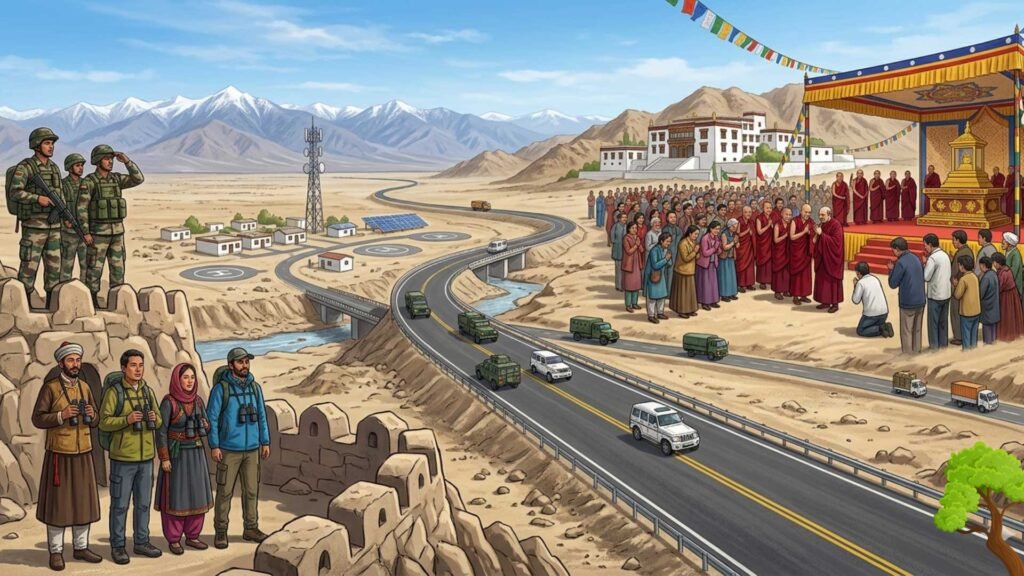
Ladakh has long functioned as a critical sentinel for the Indian state, situated at the confluence of volatile borders and rugged geography. For the local populace, this proximity to the border has often meant living under the shadow of geopolitical uncertainty, where the defense of the nation was not just a policy position but a daily lived reality. The government acknowledgment of this contribution recognizes the unique role Ladakhis have played in maintaining national sovereignty.
The 2019 Administrative Transformation
The administrative transformation of Ladakh into a Union Territory in 2019 represented a historic reconfiguration of India internal map. This change effectively delinked the region from the complex legislative processes of its former statehood, allowing for direct oversight from the central government. Supporters argue that this model is necessary to expedite infrastructure development and bypass bureaucratic inertia that previously stymied growth in high-altitude terrain.
Dairy Expansion and Aatmanirbhar Bharat
A central pillar of the current development agenda is the expansion of the dairy sector, which is being marketed as a vital component of the broader Aatmanirbhar Bharat or self-reliant India initiative. By investing in local dairy infrastructure, the administration aims to create sustainable livelihoods for pastoralist communities and reduce dependence on supplies transported from mainland India. This is a crucial move for food security in a region where logistics are frequently disrupted by seasonal weather patterns.
Historically, Ladakh economic model relied heavily on seasonal tourism and small-scale agriculture. However, the reliance on tourism creates a precarious economic base, susceptible to global shocks and regional tensions. Diversifying into dairy production and other small-scale industries is an attempt to create a more resilient economic foundation that can support the local population year-round, regardless of tourist footfall or geopolitical stability.
Strategic Development Shift Since 2019
The following table summarizes the strategic shift in the developmental focus of the Ladakh Union Territory since its inception:
| Sector | Pre-2019 Focus | Post-2019 Focus |
|---|---|---|
| Administrative | State-level oversight | Direct Union Territory control |
| Economic | Tourism reliance | Dairy and local self-reliance |
| Cultural | Limited recognition | Official status for local languages |
| Infrastructure | Minimal connectivity | Accelerated road and utility links |
Cultural Identity and Local Governance
The cultural dimension of this development policy is equally significant. The government has taken steps to ensure that the unique linguistic and cultural identity of the Ladakhi people is preserved, even as the region undergoes rapid administrative changes. Recognizing local languages in administrative functions is a move intended to foster a sense of belonging and bridge the gap between the distant center in New Delhi and the remote mountainous communities of the north.
Comparing this model to other mountain regions reveals similar trends globally. For instance, the development of the Tibetan plateau or the Andean regions often involves a trade-off between national connectivity and local autonomy. India attempt in Ladakh is characterized by a push for deep integration, ensuring that the local infrastructure is modernized to match the standards of mainland urban centers, thereby creating a sense of parity among citizens across different geographical zones.
Legislative frameworks like the Ladakh Autonomous Hill Development Council have been reinforced to provide a measure of local agency, though critics continue to argue that more legislative teeth are needed to protect land rights and environmental integrity. The challenge for the central administration lies in balancing the rapid construction of roads, telecommunications, and dairy units with the fragile ecological balance of the Himalayas, which are increasingly vulnerable to climate change.
Civic Engagement and Environmental Sustainability
Civic engagement in this context has become more dynamic. As the region integrates further into the national fold, residents are increasingly participating in discussions regarding environmental regulations and the allocation of central funds. This burgeoning civic consciousness is a natural byproduct of increased government attention and the desire among the youth to have a greater voice in their future.
For the average citizen, the current trajectory presents both opportunity and risk. While infrastructural investment promises better connectivity and health outcomes, there is an underlying concern about the potential for cultural dilution and the pressure of development on the environment. Policy experts suggest that the next phase of development must focus on sustainable practices, such as renewable energy deployment and eco-conscious tourism, to ensure that the region remains habitable for future generations.
Looking ahead, the success of the current administration policy will be measured not just by the number of projects inaugurated but by the long-term improvement in the quality of life for the average Ladakhi. Strengthening the administrative capacity to manage such growth is essential to prevent the pitfalls of rapid, unplanned development that have affected other mountainous regions globally.
The role of regional stakeholders, including local community leaders and environmental activists, will be critical in shaping the future of this territory. As India continues to navigate the complexities of its northern frontiers, the focus on Ladakh remains a testament to the fact that internal development and border security are inextricably linked. The path toward a self-reliant Ladakh is a long-term project that requires a balanced approach to economic ambition and cultural preservation.
Key Takeaways
- Strategic Shift: Ladakh is transitioning from a security-centric focus to an administration centered on civilian economic empowerment and self-reliance.
- Economic Diversification: The expansion of the dairy sector under Aatmanirbhar Bharat aims to reduce dependence on mainland supplies and create sustainable year-round livelihoods.
- Administrative Directness: Since becoming a Union Territory in 2019, Ladakh has seen accelerated infrastructure development through direct central government oversight.
- Identity and Ecology: A major ongoing challenge involves balancing rapid modernization with the preservation of Ladakhi cultural identity and the fragile Himalayan ecosystem.
Follow us on Instagram (@inner_detail) for more updates in your feed.